
By Dr. Asim Qureshi
Musculoskeletal problems are among the most common issues seen across healthcare today. Foot pain, knee instability, balance disorders, diabetic foot complications, sports injuries, and post-surgical recovery all place ongoing pressure on clinics, rehabilitation providers, and healthcare systems.
Custom orthotics can play a meaningful role in improving mobility, comfort, and biomechanical support for many of these patients. Yet despite advances across nearly every other area of healthcare technology, the way orthotics are manufactured has remained largely unchanged for decades.
The traditional process is familiar to most clinicians: foam impressions or plaster casts, manual modifications in the lab, vacuum-formed shells, and shelves filled with physical molds that are difficult to store, reproduce, or manage efficiently.
In many cases, device quality depends heavily on the experience of a small number of highly skilled technicians. Turnaround times can vary, remakes are often difficult to standardize, and scaling fabrication across a growing healthcare organization remains operationally challenging.
A new model is beginning to emerge.
Instead of every clinic operating its own traditional fabrication setup, healthcare organizations are increasingly exploring centralized digital orthotics labs that quietly handle the technical side of design and manufacturing behind the scenes.
One example of this approach is Precision Steps Orthotics Innovation Lab in Houston, Texas.
The lab is built around a straightforward concept: clinics continue focusing on patient evaluation, diagnosis, and treatment planning, while digital fabrication specialists manage orthotic design and manufacturing through modern digital workflows.
From Physical Casting to Digital Scanning
In a typical workflow, the process begins in the clinic with a quick three-dimensional scan of the patient’s feet.
Using devices such as iPhone Face ID scanners or similar structured-light scanning systems, providers can digitally capture foot geometry and positioning without foam boxes, plaster casts, or messy physical molds.
The scan then becomes part of the patient’s digital record — similar to imaging or other diagnostic documentation.
Because the process is fully digital, providers can archive scans for future adjustments, remakes, or additional orthotic pairs without repeating the original casting process.
Digital Design Instead of Physical Molds
Once captured, the scan is transmitted to the lab where the orthotic is designed digitally using CAD-based software rather than through hand-modified physical molds.
Technicians can precisely adjust:
- heel cup depth
- arch contouring
- forefoot posting
- pressure redistribution
- flexibility zones
- support structures
If a prescribing podiatrist or therapist requests modifications on a future pair — such as slightly firmer arch support or greater flexibility under a specific region of the foot — adjustments can be made directly within the software instead of restarting fabrication from scratch.
This creates a far more flexible and repeatable workflow for both providers and patients.
The Role of Additive Manufacturing
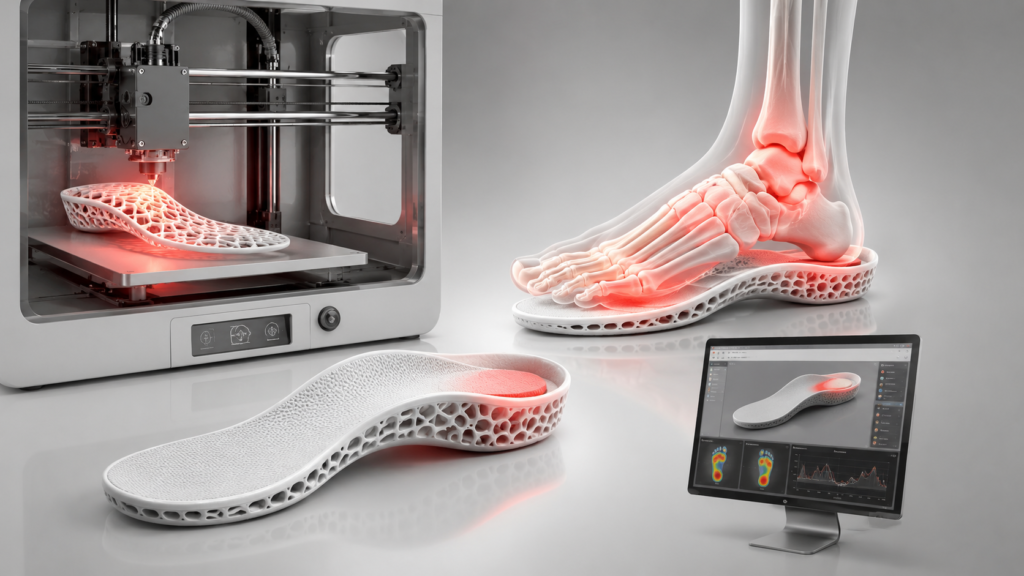
After design approval, the devices are produced using three-dimensional printers and performance polymers designed for orthotic applications.
Because the orthotics are manufactured layer by layer from digital files, different regions of the device can be engineered with varying support characteristics while maintaining a thin, lightweight profile.
The result is often a device that feels less bulky inside the shoe while still providing targeted biomechanical support.
For patients, comfort and wearability matter. Devices that are lighter, thinner, and more comfortable are generally more likely to be worn consistently over time.
Why Digital Orthotics Labs Matter
For healthcare organizations, centralized digital orthotics labs offer several operational advantages.
More Predictable Turnaround Times
Digital workflows simplify the path from scan to finished device. When most design and production steps occur within software-driven systems, fabrication timelines become easier to standardize and manage.
Greater Manufacturing Consistency
Each orthotic is tied to archived digital files and repeatable print settings, helping ensure consistency across multiple devices and future remakes.
For multi-location provider groups, this creates opportunities to standardize around preferred clinical protocols and posting philosophies.
Reduced Operational Friction
Clinics no longer need to maintain large fabrication rooms, manage plaster storage, or oversee extensive manual modification workflows.
Replacements and remakes can often be handled through archived digital records instead of repeating the entire casting process.
Better Long-Term Insight
As larger volumes of orthotic cases move through centralized digital systems, fabrication labs can begin identifying patterns in how certain device designs perform across diagnoses, activity levels, or patient populations.
Those insights may eventually help providers refine treatment approaches while still maintaining full clinical authority over prescriptions and patient care decisions.
Supporting Providers — Not Replacing Them
Precision Steps operates strictly on a prescription-only basis and does not diagnose or treat patients directly.
Its role is to serve as a manufacturing and design partner for:
- podiatry clinics
- orthopedic practices
- sports medicine groups
- physical therapy providers
- chiropractic clinics
- spine and pain management centers
For many organizations, building an in-house digital orthotics lab from scratch requires substantial investment in equipment, staffing, software, and workflow development.
Partnering with centralized digital fabrication labs offers an alternative path toward modernization without significantly increasing operational complexity.
Quiet Infrastructure in a Changing Healthcare System
Digital orthotics labs are unlikely to become flashy healthcare headlines.
But as healthcare systems continue facing pressure around staffing, efficiency, standardization, and patient experience, the infrastructure behind musculoskeletal care is becoming increasingly important.
The way orthotics are designed and manufactured can either slow healthcare workflows down or help modernize them.
Digital fabrication labs like Precision Steps represent one example of how orthotic manufacturing is evolving alongside the broader transformation occurring across healthcare technology.