
By American Chamber of Health | News & Insights
The Redefinition of a Profession
For generations, the identity of a physician has been anchored in clinical expertise. Diagnosis, treatment, and patient care have defined both the scope and the perception of the profession.
That definition is no longer sufficient.
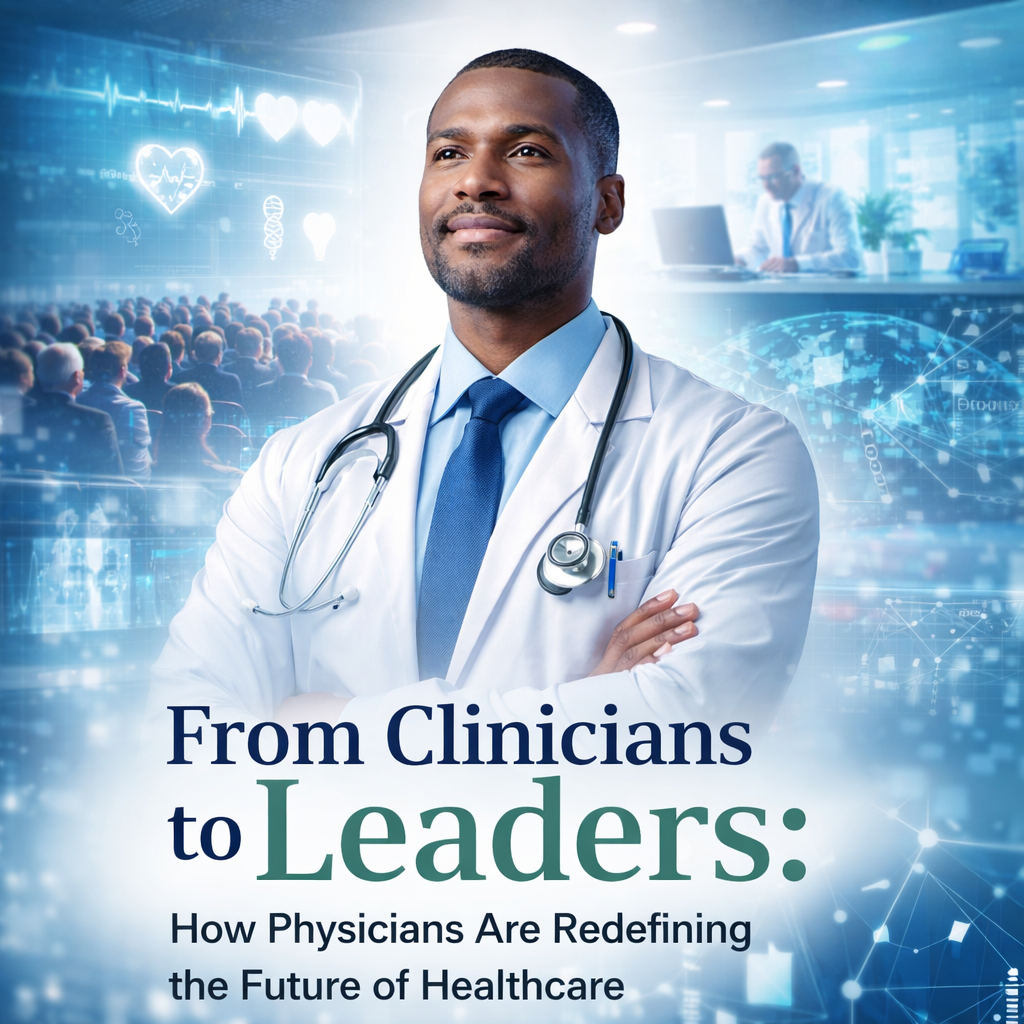
Across the United States and globally, a structural shift is underway. Physicians are moving beyond the confines of the exam room into roles that influence how healthcare is designed, delivered, and understood. This is not a temporary evolution driven by technology or policy. It reflects a deeper recalibration of where authority in healthcare resides.
The modern physician is no longer only a provider of care. Increasingly, they are becoming architects of the system itself.
A System Demanding New Leadership
Healthcare today operates within a landscape shaped by rising costs, aging populations, fragmented delivery models, and accelerating technological change. These pressures have exposed the limitations of traditional structures and created a demand for more informed, experience-driven leadership.
In this environment, physicians occupy a uniquely powerful position.
They are the only stakeholders who operate at the intersection of clinical decision making, patient experience, and system inefficiencies. This vantage point provides not only insight, but responsibility.
Physicians are now contributing to areas that were once considered outside the scope of clinical practice, including organizational strategy, technology adoption, policy development, and population health management.
What was once optional is becoming essential.
The Emergence of the Physician Voice
At the same time, a parallel shift is occurring in the public sphere.
Healthcare discourse has expanded rapidly across digital platforms, media channels, and policy forums. Yet for years, these conversations have often lacked direct clinical perspective.
That gap is beginning to close.
Physicians are increasingly engaging with broader audiences, translating complex medical knowledge into accessible insights, and shaping conversations around prevention, treatment, and public health. In doing so, they are redefining influence in healthcare.
The implications are significant. When physicians participate in public dialogue, they introduce credibility into spaces often dominated by speculation or incomplete information. At scale, this influence can alter patient behavior, inform policy decisions, and elevate the overall quality of healthcare discourse.
The physician is no longer only a voice within the system. They are becoming a voice that shapes it.
Technology as a Force Multiplier
This transformation is being accelerated by advances in digital technology.
Telehealth, artificial intelligence, and real time communication platforms have expanded the reach of medical expertise beyond physical boundaries. A single physician can now educate thousands, collaborate globally, and contribute to innovation in ways that were previously unattainable.
Importantly, these technologies do not diminish the role of the physician. They amplify it.
They allow physicians to operate not only as caregivers, but as educators, strategists, and thought leaders. In doing so, they are redefining both the scale and the nature of medical impact.
Leadership as an Extension of Care
Perhaps the most consequential shift is conceptual.
Leadership is no longer separate from clinical practice. It is becoming an extension of it.
Physicians bring a depth of understanding that is difficult to replicate. They see firsthand where systems succeed and where they fail. They understand the human consequences of inefficiency, fragmentation, and delay.
This positions them to lead not only in clinical settings, but in system design, operational strategy, and innovation in care delivery.
Evidence increasingly suggests that physician involvement in leadership roles is associated with improved outcomes, stronger organizational performance, and more effective implementation of value based care models.
The implication is clear. Healthcare systems function better when physicians help shape them.
The Structural Barriers to Transformation
Yet this transition is not without friction.
Physicians continue to operate within environments defined by time constraints, administrative burden, and limited formal pathways into leadership. Many lack access to training in business, policy, or systems thinking. Others encounter institutional structures that restrict influence beyond clinical roles.
At the same time, the expectation to be both an exceptional clinician and an effective leader introduces new pressures.
This is not simply an individual challenge. It is a structural one.
For the transformation to succeed, healthcare organizations must create conditions that enable physicians to expand their roles without compromising the quality of care.
The Role of Platforms in Shaping Influence
In this context, access becomes as important as expertise.
The ability to lead, influence, and contribute at scale depends not only on knowledge, but on visibility, connection, and engagement. This is where professional networks and institutional platforms play a defining role.
Organizations such as the American Chamber of Health are positioned to bridge this gap by providing physicians with opportunities to engage beyond traditional practice. Through collaboration, knowledge exchange, and increased visibility, these platforms enable physicians to extend their impact into areas that shape the future of healthcare.
Influence, in today’s environment, is not incidental. It is structured.
A Defining Moment for the Profession
The evolution of the physician role reflects a broader transformation within healthcare itself.
Systems are moving toward models that are integrated, data driven, and patient centered. These models require leadership that is grounded in clinical reality and informed by experience.
Physicians are uniquely equipped to provide that leadership.
The question is no longer whether they should lead. It is whether the system will evolve quickly enough to support them.
Conclusion
The modern physician is no longer defined solely by clinical expertise. They are becoming leaders, educators, and influential voices shaping the trajectory of healthcare.
Those who embrace this expanded role will not only impact individual patients, but will help define how care is delivered at scale.
For the American Chamber of Health, this moment represents more than an opportunity. It represents a responsibility to support, elevate, and connect physicians who are prepared to lead beyond the exam room.
The future of healthcare will not be determined by systems alone. It will be shaped by those who have the authority, insight, and vision to transform them.