
The global healthcare sector is facing one of its most urgent and complex challenges. A projected shortage of 11 million healthcare workers by 2030 is forcing policymakers, providers, and global institutions to rethink how the workforce of the future will be trained, retained, and sustained.
This shortage is not just a workforce issue. It represents a critical risk to the stability of healthcare systems worldwide, particularly as demand continues to rise due to aging populations, increasing chronic disease burden, and expanding access to care. At the same time, experts point to a significant opportunity. Addressing this gap could unlock more than one trillion dollars in economic value, underscoring the strategic importance of workforce planning in the years ahead.
Industry leaders are increasingly aligned on the need to move beyond short term recruitment models toward more sustainable and structured workforce strategies. Rather than relying heavily on international hiring alone, there is growing emphasis on building strong domestic training pipelines while maintaining balanced global collaboration.
One of the central themes emerging from recent discussions is the need to better understand the root causes of workforce attrition. Retention is no longer viewed as a secondary concern but as a primary driver of long term system resilience.
Hein Van Eck, Chief Executive Officer of Mediclinic Middle East, highlighted a critical challenge faced by many healthcare systems:
“It is not a problem for us to get skilled workers into the system, but it is a problem that we lose highly skilled unit managers who are very scarce to come by. We have to acknowledge the fact that they are not leaving for money. They are leaving to gain a passport for their family and for future generations. We need to make sure we always have a good pipeline growing and we show them there is future career progression. The push to become self reliant is certainly there, so it is moving in the right direction.”
This insight reflects a broader reality across global healthcare markets. Workforce mobility is driven by long term personal and professional considerations, not just compensation. As a result, healthcare organizations must rethink how they create career pathways, stability, and long term value for their employees.
At the same time, healthcare leaders are focusing on building structured education and training ecosystems that can support future demand. Expanding local training capacity, strengthening academic partnerships, and aligning education with employment opportunities are seen as essential steps in building a sustainable workforce.
Mohaymen Abdelghany, Group Chief Executive Officer of Fakeeh Health, emphasized the importance of addressing factors within organizational control. He pointed to the need for structured retention strategies combined with a significant expansion of local training programs. The presence of hundreds of students and trainees already progressing through these systems signals that long term transformation is beginning to take shape.
From a global perspective, workforce strategy is also becoming more interconnected. Countries are increasingly looking beyond their borders to develop collaborative workforce models that balance local capacity with international partnerships.
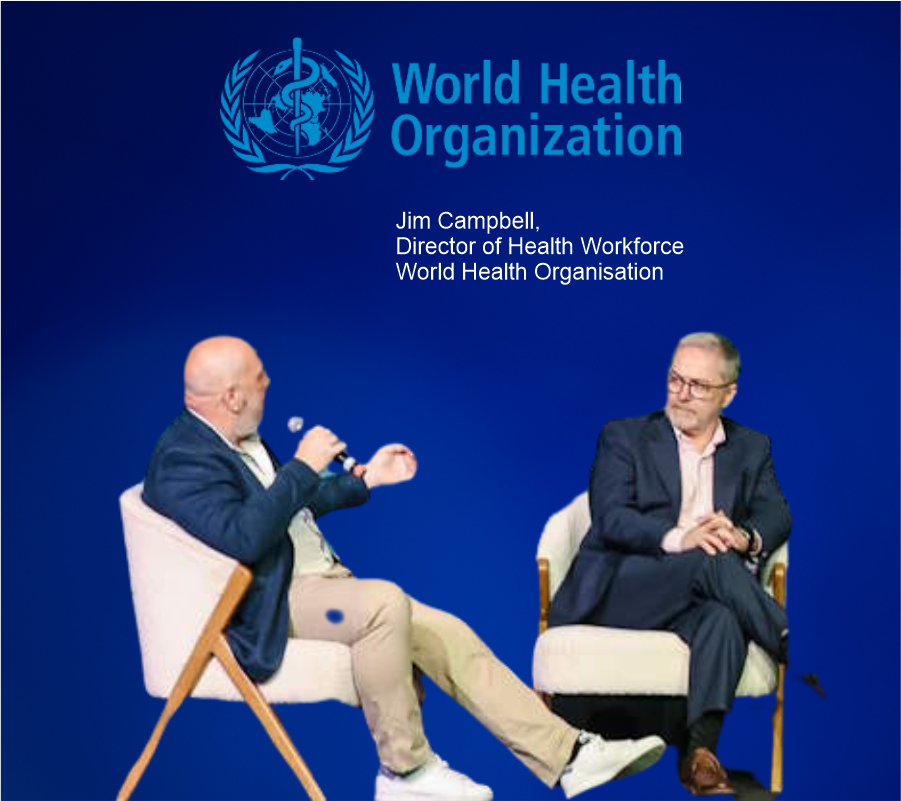
Jim Campbell, Director of Health Workforce at the World Health Organisation, highlighted a significant shift in how workforce planning is being approached:
“There is a workforce strategy being developed currently. It started last year. It is the first ever federal strategy looking at a 10 to 15 year account. The country is the first to intentionally understand labour economics and markets in healthcare. We have economic demand, but a limited supply currently. And so the intention looked at the opportunity to work with Africa and to work with the diaspora.”
His comments point to a more sophisticated and data driven approach to workforce planning, one that integrates labor market dynamics, education systems, and international collaboration into a single strategic framework.
The broader takeaway from these discussions is clear. Solving the healthcare workforce crisis will require coordinated action across multiple fronts. Stronger domestic training pipelines must be combined with smarter retention strategies and responsible global partnerships. At the same time, workforce planning must be grounded in long term economic and demographic realities rather than short term fixes.
As healthcare systems continue to evolve, technology will play an important role in improving efficiency and extending care delivery. However, the foundation of every healthcare system remains its people. The ability to train, retain, and support a skilled workforce will ultimately determine the resilience and effectiveness of healthcare systems in the decade ahead.