
Based on insights from World Health Expo and industry trends.
Healthcare systems around the world are investing heavily in digital transformation, yet many continue to struggle with rising costs, workforce burnout, and inconsistent patient outcomes. The problem is not a lack of innovation. It is a lack of integrated leadership.
Too often, hospitals treat strategy, technology, patient experience, and workforce management as separate priorities. In reality, sustainable performance emerges only when these elements are aligned under a cohesive leadership model.
A growing number of institutions are beginning to close this gap. One example, highlighted in a recent leadership discussion featured by World Health Expo, illustrates how a more integrated approach can be operationalized in practice.
What emerges is not just a case study, but a replicable leadership model.
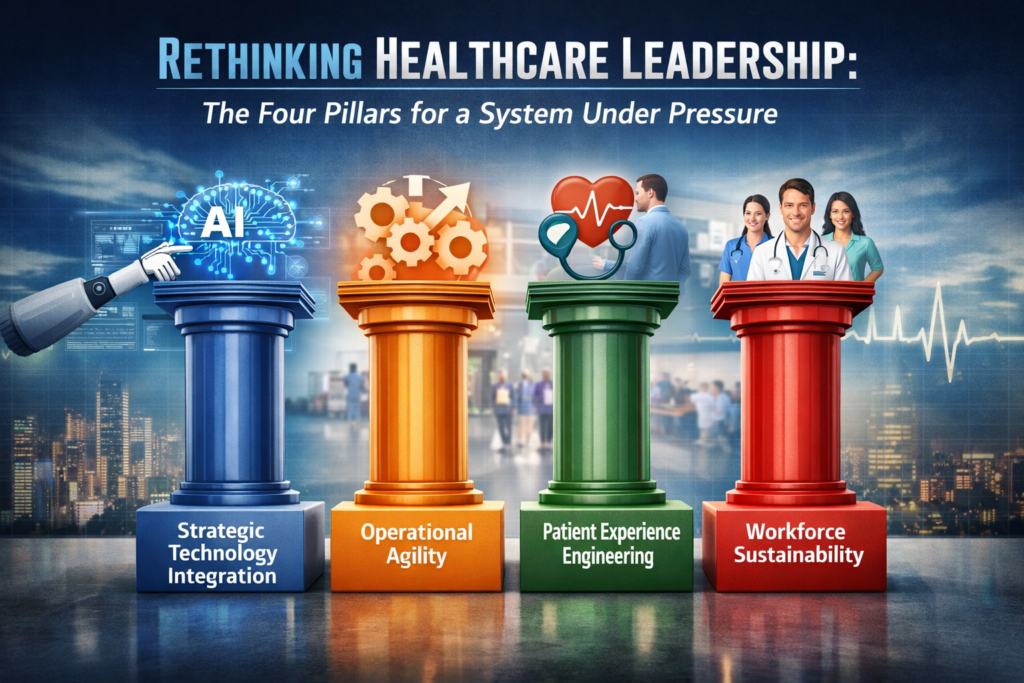
Based on observed practices, effective healthcare organizations are converging around four core pillars:
1. Strategic Technology Integration
Technology must move from a support function to a strategic driver of outcomes.
Leading institutions are not simply adopting AI or digital systems. They are embedding them into clinical and operational workflows. This includes using AI assisted diagnostics to reduce variability in clinical decisions, integrating data systems to improve real time visibility, and strengthening cybersecurity as a core component of patient trust.
The key shift is this:
Technology is no longer an enabler of strategy. It is part of the strategy itself.
2. Operational Agility
Healthcare organizations are operating in a state of continuous disruption, from regulatory shifts to changing patient expectations.
Traditional administrative models, designed for stability, are increasingly ineffective. High performing institutions instead prioritize agility by streamlining decision making, reducing bureaucratic friction, and enabling faster responses to change.
This requires leadership structures that are both decentralized enough to act quickly and coordinated enough to maintain consistency.
Without this balance, innovation efforts stall before they reach execution.
3. Patient Experience Engineering
Patient centered care has long been a stated priority, but in many systems it remains conceptual rather than operational.
What differentiates leading organizations is their ability to engineer the patient experience across the entire journey, from first interaction to post treatment follow up.
This involves designing seamless transitions between departments, reducing wait times through process optimization, and using data to personalize communication and care pathways.
The outcome is not only higher patient satisfaction, but improved clinical results and stronger long term engagement.
4. Workforce Sustainability
No healthcare system can outperform the strength of its workforce.
Yet globally, healthcare providers are facing acute staffing shortages, high turnover, and burnout. Addressing this requires more than incremental improvements. It demands a shift in how organizations view their people.
Forward looking institutions treat workforce strategy as a core leadership responsibility, focusing on long term retention rather than short term staffing, continuous professional development, and organizational cultures that prioritize well being alongside performance.
The evidence is increasingly clear. Workforce stability is not a byproduct of success. It is a prerequisite for it.
What distinguishes leading healthcare organizations is not excellence in any one pillar, but the integration of all four.
Technology investments improve patient experience.
Operational agility enables workforce sustainability.
Workforce engagement strengthens execution across every function.
When these elements are aligned, organizations move from reactive management to proactive leadership.
This integrated model also resolves a common tension in healthcare, the perceived trade off between financial performance and quality of care. In practice, organizations that align these pillars are better positioned to achieve both.
For healthcare providers in fast growing and diverse markets such as Texas, the implications are immediate.
Population growth, demographic diversity, and increasing demand for services are placing additional pressure on existing systems. Scaling capacity without compromising quality requires more than expansion. It requires redesign.
Leaders in these environments must build systems that scale operationally without increasing complexity, deliver consistent care across diverse patient populations, and anticipate regulatory and technological shifts rather than react to them.
The four pillar model provides a framework for doing so.
The future of healthcare will not be defined solely by technological advancement or capital investment. It will be defined by leadership models that can integrate complexity into coherent execution.
Organizations that continue to treat strategy, technology, patient experience, and workforce as separate domains will struggle to adapt. Those that align them will set the pace for the industry.
The question facing healthcare leaders is no longer whether transformation is necessary.
It is whether their leadership model is designed to deliver it.