By the American Chamber of Health Editorial Desk
A structural transformation is underway in the American healthcare system, one that is not being led by hospitals, physicians, or insurers alone, but by real estate.
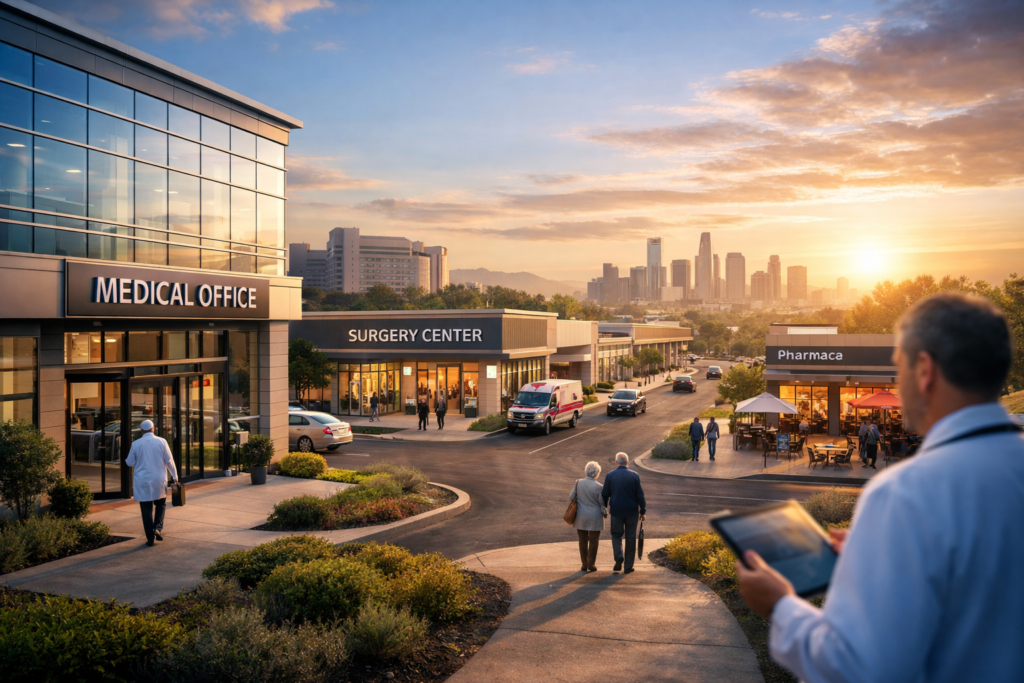
Across the United States, healthcare delivery is moving out of centralized hospital campuses and into communities such as retail corridors, suburban developments, and purpose built outpatient facilities. This is not a temporary adaptation. It is a long term reconfiguration of how care is accessed, delivered, and financed.
At the center of this shift is medical real estate, an asset class that until recently occupied a relatively quiet corner of the commercial property market. Today, it is emerging as one of the most resilient and strategically important sectors in the American economy.
The Demographic and Economic Imperative
The forces driving this transformation are both demographic and financial.
Healthcare spending in the United States now exceeds 17% of GDP, placing it among the largest components of national economic activity. At the same time, the population is aging rapidly. By 2040, Americans aged 65 and older are expected to grow by nearly 70%, fundamentally reshaping demand for care.
This demographic shift carries profound implications. Older Americans utilize healthcare services at significantly higher rates, particularly for chronic conditions that require ongoing, accessible treatment rather than episodic hospital based care.
The traditional hospital centric model is not built for this reality. It is expensive, capacity constrained, and often geographically disconnected from where patients live.
The Rise of the Outpatient Economy
In its place, a new model is emerging, one defined by outpatient care.
Over the past decade, advances in medical technology, reimbursement pressures, and consumer expectations have accelerated the migration of procedures away from hospitals. Surgeries that once required multi day admissions are now performed in ambulatory settings. Diagnostics, specialist consultations, and chronic care management are increasingly delivered in local, community based facilities.
Patients are choosing convenience. Providers are pursuing efficiency. Insurers are enforcing cost discipline.
The result is a structural shift toward decentralized care and a corresponding surge in demand for medical office buildings, ambulatory surgery centers, and specialty clinics located closer to population centers.
Real Estate as Healthcare Infrastructure
This transformation is redefining the role of real estate in healthcare.
Unlike traditional office properties, which continue to face elevated vacancy rates and uncertain demand, medical outpatient facilities are operating from a position of strength. Vacancy rates in medical office buildings typically remain in the high single digits, compared to significantly higher levels in conventional office sectors. Occupancy in many major markets is at or near historical highs.
The reason is straightforward. Healthcare is not optional, and it is not fully virtual. It requires physical infrastructure that is specialized, regulated, and geographically proximate to patients.
These properties are not interchangeable with traditional office space. They are purpose built assets, often supported by long term leases, high tenant retention, and stable cash flows. For investors, they offer a rare combination of durability and predictability.
Institutional capital has taken notice.
Real estate investment trusts such as Welltower Inc. and Ventas Inc. have significantly expanded their exposure to outpatient assets. Private equity firms and pension funds are increasingly allocating capital to healthcare real estate, drawn by its defensive characteristics and long term growth profile.
Supply Constraints and the Pricing Gap
Yet even as demand accelerates, supply is tightening.
Rising interest rates, elevated construction costs, and regulatory complexity have slowed the development pipeline for new medical facilities. Ground up projects have become more difficult to finance, while the cost of building specialized healthcare space continues to climb.
The result is a widening gap between supply and demand.
Existing assets are benefiting from higher occupancy, rent growth, and strong tenant demand. New developments, while more capital intensive, are commanding premium pricing and strategic importance within healthcare systems seeking to expand their outpatient footprint.
This imbalance is creating a compelling and potentially time sensitive opportunity for investors and developers with the expertise to navigate the sector.
A Temporary Slowdown, Not a Structural Weakness
The recent rise in interest rates has introduced friction into real estate capital markets. Transaction volumes have declined, and pricing has adjusted across asset classes, including healthcare properties.
But unlike other sectors, the underlying fundamentals of medical real estate remain intact.
Demand continues to be driven by non cyclical factors such as aging demographics, clinical innovation, and systemic cost pressures. Occupancy remains strong. Supply remains constrained.
As financing conditions stabilize, even modestly, capital is likely to return quickly to the sector. Many investors are already positioning for the next cycle, recognizing that the long term trajectory is not in question.
The Strategic Repositioning of Healthcare Providers
For healthcare providers, this shift represents more than a change in location. It is a strategic realignment.
Real estate is no longer a passive cost center. It is becoming an active driver of growth, patient acquisition, and operational efficiency.
Health systems are increasingly investing in distributed networks of outpatient facilities designed to capture demand closer to where patients live and work. Retail conversions, suburban medical campuses, and integrated care hubs are becoming central components of expansion strategies.
In this model, proximity is not just a convenience. It is a competitive advantage.
The Future: Decentralized, Accessible, and Real Estate Driven
What is emerging is a fundamentally different healthcare system, one that is decentralized, consumer oriented, and deeply integrated with the built environment.
Hospitals will remain essential, particularly for acute and complex care. But they will no longer serve as the primary gateway to the system.
That role is shifting to a network of outpatient facilities that extend healthcare into the fabric of everyday life.
For investors, this represents participation in one of the most stable and essential sectors of the economy. For developers, it presents an opportunity to shape the physical infrastructure of modern healthcare. For policymakers, it underscores the need to align zoning, planning, and investment with the realities of how care is now delivered.
And for patients, it promises something simpler but no less significant, care that is closer, faster, and more accessible.